|
.: Brief History of Accra
:: Academy |
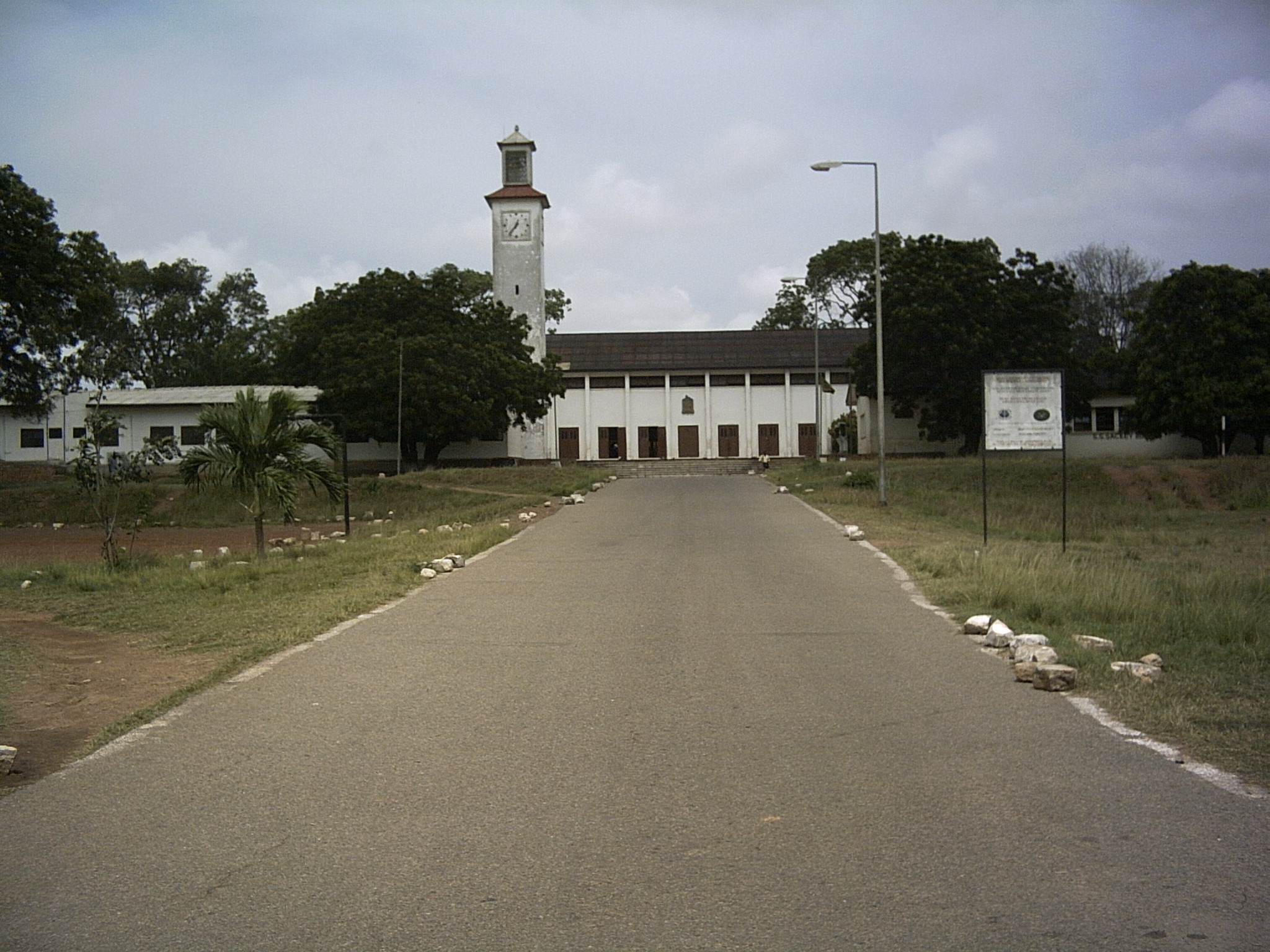
On a gentle hill to the north as one enters Accra by the Winneba Road, a tall white tower beshadows the campus of Accra Academy.
The story of Accra Academy, however, goes back to Ankrah Lane in the slums of James-town, where about seventy years ago, Mrs Ellen Buckle let her large two storeyed house for use as a classrom block to accomodate the newly founded Accra Academy.
It was to satisfy the urgent need for a secondary school which would provide goo tuition at a reasonable cost to children from less fortunate homes who ha the aptitude but whose parents could not afford to send them to schools like Achimota, Mfantispim and Adisadel that the late K.G. Konuah (BA, Durham), the late G.N. Alema (BA, Oxon), the late S.N. Awuletey (inter BA, Durham) and the late J.A. Halm-Addo founded Accra Academy as a private edductional enterprise
Kofi George Konuah was born in Kumasi in 1904. He was educated at the Wesleyan Boys' High School, Freetown and Fourah Bay College where he graduated in 1928 as a Bachelor of Arts. He could conveniently have chosen to enter the legal profession which was more prestigious but heeded the timely advice of Dr. Aggrey to choose education. After a brief period in Achimota School, Dr. Konuah gathered others of similar mind to think and plan a pure African enterprise. These were James Akwei Halm-Addo, Dr. Konuah's mate at the Wesleyan Boy's High School, Gottfried Narku Alem and Samuel Neils Awuletey also graduates of Fourah Bay College.
After repair works had been completed on Ellen House and furniture procurred, Accra Acdemy was officially opened on 20th July, 1931. The school started with a student population of 19 distributes into forms one to three including A.K. Konuah (later Headmaster), C.S. Duah (later a member of the teaching staff), R.Q.E. Blankson (later Town Engineer, Accra Municipal Council) and F.G. Torto (later Professor of Chemistry at the University of Ghana, Legon).The original teaching staff comprised the four founders and two others who had just complete Mfantsipim School. These were M.F. Dei-Anang and S.S. Sackey who for twenty years worked in the dual capacity of teacher and school Bursar.
The school offtered a wide range of courses in Arts, Science and Business. Mr. S.N. Awuletey taught Shorthand and Book-keeping.Today, Accra Academy stands as one of the foremost institutions in the ocuntry firmly built on the foundation laid by S.N. Awuletey. Mr. W.K. Lutterodt set up the Science department and arranged practical lessons at Achimota School at weekends for his students while Mr. G.N. Alema taught Agricultural Science and held practical lessons on his farm.
In December, 1932, the first batch of ten students were presented for the Junior Cambridge School Certificate Examination. Seven of these passed. In 1939, forty-five students were entered for the Senior Cambridge SChool Certificate Examination. Forty-two of these passes of whom ten obtained exemption form the London Matriculation Examination.
The impressive results recorded by the school soon caught the attention of the Department of ducation and in 1947, a recommendation was made to the Director of Education to place Accra Academy on the list of government assisted schools and from 1st January, 1950, Accra Academy became a government assisted secondary school.recorded by the school soon caught the attention of the Department of ducation and in 1947, a recommendation was made to the Director of Education to place Accra Academy on the list of government assisted schools and from 1st January, 1950, Accra Academy became a government assisted secondary school.After repair works had been completed on Ellen House and furniture procurred, Accra Acdemy was officially opened on 20th July, 1931. The school started with a student population of 19 distributes into forms one to three including A.K. Konuah (later Headmaster), C.S. Duah (later a member of the teaching staff), R.Q.E. Blankson (later Town Engineer, Accra Municipal Council) and F.G. Torto (later Professor of Chemistry at the University of Ghana, Legon).The original teaching staff comprised the four founders and two others who had just complete Mfantsipim School. These were M.F. Dei-Anang and S.S. Sackey who for twenty years worked in the dual capacity of teacher and school Bursar.
The school offtered a wide range of courses in Arts, Science and Business. Mr. S.N. Awuletey taught Shorthand and Book-keeping.Today, Accra Academy stands as one of the foremost institutions in the ocuntry firmly built on the foundation laid by S.N. Awuletey. Mr. W.K. Lutterodt set up the Science department and arranged practical lessons at Achimota School at weekends for his students while Mr. G.N. Alema taught Agricultural Science and held practical lessons on his farm.
In December, 1932, the first batch of ten students were presented for the Junior Cambridge School Certificate Examination. Seven of these passed. In 1939, forty-five students were entered for the Senior Cambridge SChool Certificate Examination. Forty-two of these passes of whom ten obtained exemption form the London Matriculation Examination.
The impressive results recorded by the school soon caught the attention of the Department of ducation and in 1947, a recommendation was made to the Director of Education to place Accra Academy on the list of government assisted schools and from 1st January, 1950, Accra Academy became a government assisted secondary school
Even though the school started as a day school, accomodation was later on secured in Claremont House a storey building adjoining Ellen House to provide limited boarding facilities. Among those who benefitted from this facility was D.F. Annan the former Speaker of Parliament.
In the course of time the school began to work towards the acquisition of a plot of land for the erection of permanent building structures. Plots acquired at Kokomlemle and later Korle Gonno were given up because of protracted litigation and remoteness of site, respectively. In 1957, however, the school was offered a thirty-seven acre plot at Bubuashie, off Winneba Road by the C.P.P. government as a result of negotiations which Mr. J.A. Halm-Addo was very instrumental. The contract for the construction of permanent buildings on the new site was awarded to J. Monta & Sons in October, 1959. Actual work on the site began in December, 1959, and in July, 1961, - teh thirtieth anniversary of the founding of the school- the contractor handed over the completed buildings to school authorities.
| In September of that year, staff and students moved to the present site. the new buildings were officially opened later in February, 1962, by Mr. A.J. Dowuona-Hammond, then Minister of Education. A dormitory block to provide boarding facilities was completed in 1966.
By 1965, the student enrolment had risen to nearly 600, one third of whom continued to be day students. Due to its exceptional academic attainments, a Sixth Form department was added to help the products of the school who qualify to gain ready admission into this sector. The courses offered initially were the Arts and Sciences. Fifteen Arts students and eight Science students were offered admission for the 1961/62 academic year.
Business Education was incorporated into Sixth Form studies in the school in Septembet, 1970.
The fiftieth year 1981 of Accra Acdemy outdoored a full fledged second cycle institution with a student population of 900. Staff establishment was 52.
The period also recorded laudable attainments in sports. As early as 1934, the school appointed a sports master to run the students sporting activities licke soccer, athletics, and hockey. Inadequate sporting facilities did no deter the sportsmen. The made their mark on the national sports map. The school won the Aggrey Shield together with seven other enviable trophies in the annual inter-college athletics competition in 1950. It was from this competetion that the slogan "Accra Aca, Bleoo" came intp being. Some of the outstanding national athletes produced by the school are: Mr. Adjin-Tettey,ex-senior Athletics coach of the National Sports Council, Mr. Kofi Aryeetey, also of the National Sports Council, Mr. J.K. Aduakwa, coach, University of Ghana; Mr. Alex Asiedu, Director, Sports College, Winneba; Mr. Ohene Djan, Director of Sports (C.O.S.) during the First Republic; Mr. E.J.C. Quaye andd Mr. H.P. Nyemitei, nationally acclaimed sportsmen were also oldboys who contributed immensely to sports in Ghana. |
|